The short answer
On custom printed shrink sleeve labels, the printing press is rarely what delays your order. The cylinder and the dieline are. If you have a launch date tied to a specific SKU, finalize your artwork and dieline before you start comparing quotes from shrink sleeve suppliers—because in my experience, a week lost to "let me get you our pricing" is a week you'll spend later paying to compress.
Everything below is the reasoning, one real case with numbers, and the situations where this advice doesn't apply.
Why I'm confident saying that
I coordinate rush jobs at a packaging sourcing company—mostly beverage, personal care, and small-batch food clients. I've handled roughly 140 rush shrink sleeve orders over the past four years, including several same-flat-size turnarounds that needed finished rolls on a press within 72 hours.
In March 2025, a beverage client called on a Tuesday afternoon, eleven days out from a retail buyer meeting, with a problem. Their regular shrink sleeve manufacturer had quoted a 15-business-day turnaround, and the client had assumed that was a floor, not a range. It wasn't a floor. We got them sorted, but the extra $1,100 in expedite fees we paid on their behalf wasn't the real cost. The real cost was that their label designer had to rework the dieline for a slightly different lay-flat width because the faster vendor ran a different seamer setup. That's the part nobody budgets for.
When I first started sourcing custom shrink wrap labels, I assumed price was the variable that mattered. Three delayed jobs later, I learned it's actually spec compatibility across vendors. (Note to self: write that up as a proper internal checklist one of these days.)
Where the time actually goes
For a standard full-body shrink sleeve on a 2-liter bottle, here's roughly how a 15-business-day quote breaks down (based on quotes we've collected from U.S. and overseas shrink sleeve suppliers between Q2 2024 and Q1 2025):
- Artwork review and prepress: 1-2 business days
- Cylinder engraving (rotogravure) or plate making (flexo): 3-7 business days
- Printing and seaming: 2-4 business days
- Curing, slitting, and QC: 1-2 business days
- Shipping: 1-5 business days depending on origin
See the problem? The cylinder step alone can eat half the total timeline, and it can't be compressed by throwing money at shipping. A shrink sleeve manufacturer can't print your job until the cylinder exists.
This is where the question most buyers ask and the question they should ask diverge. Most ask, "What's your price per 1,000?" The better question is, "Do you already have a cylinder for this spec, or will you need to cut one?" If they need to cut one, your timeline is their engraving queue, not their press schedule.
Why does this matter for a rush? Because a vendor who already has the cylinder—or who uses digital shrink sleeve printing for smaller runs—can compress 15 days into 6 or 7. Not always. But often enough that it's worth asking.
One case, in numbers
August 2024. A personal care client needed 40,000 custom printed shrink sleeve labels in 9 business days for a trade show giveaway. Standard turnaround quoted by three suppliers ranged from 12 to 18 business days. Not helpful.
We split the order. 30,000 went to a vendor with a compatible cylinder in their library (7-day turnaround, base cost around $6,400). The remaining 10,000 went digital from a shorter-run specialist (5-day turnaround, around $3,100). Total spend was roughly 15-20% above the lowest standard quote—but it landed on time.
The counterintuitive bit: the "expensive" split solution cost less than the expedite fees on a single-vendor rush would have. When we tested that option in Q3 2024, the single-vendor rush quote came back $1,900 higher than the split, before freight.
I only believed the split strategy after resisting it for a year. Every fiber of me wanted one purchase order, one vendor, one invoice. But every time I forced a single vendor on a tight timeline, either the cylinder lead time blew it up or the seaming didn't match the client's applicator. Those failures cost us maybe $2,300 in reprints across 2023 and into early 2024. Roughly, anyway—I'd have to pull the invoices to be exact.
The questions that actually move the needle
If you're sourcing shrink sleeve labels on a deadline, here's what I'd run through before you ask for a quote at all:
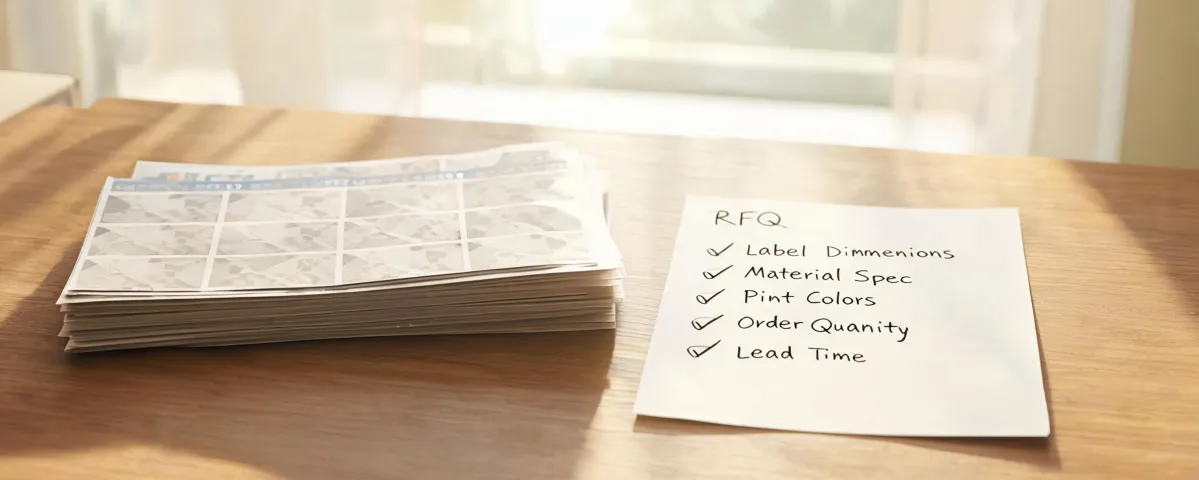
- Do you have the applicator's spec sheet? Seam type matters (solvent, hot-melt, ultrasonic), and some manufacturers won't quote without knowing what machine will apply the sleeve.
- Is the artwork final, including the distortion ratio? Shrink sleeves need artwork pre-distorted—stretched vertically—to compensate for shrinkage. If your designer hasn't done this before, budget for a revision cycle.
- What's the lay-flat width and finished sleeve diameter? Small variations here force new cylinders or new plate layouts.
- Do you need rolls or cut sleeves? Roll-fed runs are faster to produce but require your applicator to handle roll tension. Cut and stacked is slower to prep.
- What's the material? PVC, PETG, and OPS (oriented polystyrene) all behave differently under heat, and different manufacturers run different materials as standard.
The material question trips up the most people. Most buyers focus on the print and completely miss the substrate—then find out their applicator is calibrated for PETG and the vendor quoted OPS.
When this advice doesn't apply
If you're planning a launch four months out, ignore almost everything above. You have time to navigate cylinder lead times, and price shopping across five shrink sleeve suppliers is genuinely worth the effort. The bottleneck only matters when the timeline is short.
Also: if your run is under about 5,000 units, shrink sleeves may be the wrong format entirely. Pressure-sensitive labels (the peel-and-stick kind) don't need cylinders, don't need artwork pre-distortion, and can be turned around in days. I've talked two clients out of shrink sleeves in the past year because their volume didn't justify the tooling—one was a 3,000-unit run for a farmers market debut. They went pressure-sensitive and saved about $2,800 in setup.
The reverse is also true. Shrink sleeves are the format that gives you full-body 360° graphics with tamper evidence on the cap. That's a specific design capability, and it's worth the lead time when you actually need it.
One more boundary: I'm not 100% sure how vendor cylinder libraries compare outside the U.S. and a handful of European markets. My experience is almost entirely with domestic and near-shore sourcing, and international suppliers may have very different tooling economics. Take that with a grain of salt if you're sourcing from Asia or South America.
What I'd do differently next time
There's something satisfying about a rush job that lands clean. After the stress of coordinating that split order last August, seeing those rolls show up on day 8 with the seam tolerance within spec—that's the payoff that keeps you doing this work.
But the thing I'd tell my 2021 self, if I could: stop treating the cylinder as a vendor problem. It's a sourcing problem. The buyer who knows what tooling is already in their supply base will beat the buyer with the best price every single time. And the certainty of knowing your deadline will be met is usually worth more than the few percent you save shopping harder.
Prices in this article are from quotes we collected between Q2 2024 and Q1 2025 and are for general reference only. Actual pricing varies by vendor, specification, and time of order—verify current rates before committing.
